

Sandblasting Melbourne Cars & Industrial Metal So Coatings Actually Stick
Melbourne’s sandblasting market fails in three predictable ways: the operator stops returning calls after drop‑off, the price at pickup is higher than the quote, and the job that was meant to take a week quietly turns into three.
At Blast Off Surface Cleaning & Protective Coatings in Heidelberg West, we have been preparing metal surfaces for 30 years. Four technicians, each with 25–30 years of hands-on experience, work from a permanent, fully equipped workshop. This page lays out exactly what we do, what media we use, how we price it and what you can expect from the first call to the moment you collect your parts.
- 30+ years preparing and coating Melbourne metal
- In‑house abrasive blasting: sand, bead and garnet matched to your job
- Etch priming included on every job as standard, not an added extra
- Single‑source blast‑and‑coat: one quote, one workshop, one turnaround
- Fast, predictable turnaround with no hidden costs or surprise extras
ENQUIRE NOW
EXCELLENTTrustindex verifies that the original source of the review is Google. I had some bespoke grip strength and strongman gym equipment made from mild steel. I asked for a rough texture and was very happy with the result. It exceeded my expectations. Quick turnaround, easy communication and reasonable price. Great team, I highly recommend them if you are considering the service.Posted on GoogleTrustindex verifies that the original source of the review is Google. Very helpful staffPosted on GoogleTrustindex verifies that the original source of the review is Google. Very happy with the quality of work and The professional advice givenPosted on GoogleTrustindex verifies that the original source of the review is Google. The Best in the Business 👌Posted on GoogleTrustindex verifies that the original source of the review is Google. Blast off are simply the best. Great price, great quality and fast turn around. A+++Posted on GoogleTrustindex verifies that the original source of the review is Google. Peter is super helpfull quick turnaround and fairpricedPosted on GoogleTrustindex verifies that the original source of the review is Google. I first had my E.H holden fully sandblasted by Peter and his dad around 17 years ago when they were a new business. Since then, I've had them do a fair amount of stripping to confidently say they are always honest , upfront and cheap. They are good family and is no wonder why they are respected in the panel and paint game.Posted on GoogleTrustindex verifies that the original source of the review is Google. Pete’s the man, great work thanks heaps mate very very happy 😊Posted on GoogleTrustindex verifies that the original source of the review is Google. Pete and the team are specialists in looking after car restoration projects. Wouldn't go anywhere else.
What Abrasive Blasting Actually Does to a Surface
Abrasive blasting is not “cleaning.” It is surface reconstruction.
Driven at high pressure across metal, abrasive media strips rust, mill scale, old coatings and contamination back to bare metal – and it leaves behind something more important than a shiny surface: a profile.
That profile is what your coating actually bonds to. Sherwin‑Williams, one of the world’s largest coating manufacturers, estimates that up to 80% of coating failures trace back to inadequate surface preparation. Not bad powder. Not poor application. Inadequate prep.
Surface Profile and Why It Matters
Surface profile is the microscopic roughness left behind after blasting – the anchor pattern that gives a coating its mechanical grip on the substrate.
AS 1627.4 is the Australian Standard that defines surface‑cleanliness benchmarks before any coating is applied. A surface can look perfectly clean to the naked eye and still fall short of what powder‑coat adhesion actually requires.
The Australasian Corrosion Association put a number on the impact decades ago: steel that had its mill scale removed by abrasive blasting more than doubled the service life of an oil‑based paint compared to steel that was only cleaned. That work is over 70 years old, but the physics have not changed. Coatings last when they have a proper profile to hold onto – and they fail early when they do not.
What Blast Off Handles — Materials, Parts & Project Types
Thirty years of continuous operation produces a job history no brochure can fake. The work that comes through the Heidelberg West workshop includes:
Car bodies, chassis and panels — classic, vintage and project vehicles
Alloy wheels and steel rims
Motorcycle and bicycle frames
Structural steel and fabricated parts
Machinery components and industrial equipment
Cast iron garden settings and heritage ironwork
Truck parts, bullbars and subframes
These are not “services we’d like to offer.” They are the jobs we actually do, every week
Steel vs Aluminium — Why the Media Choice Changes
Media selection is a technical decision, not a preference – and getting it wrong does not just produce a sub‑standard finish. It can destroy the part.
Steel and heavily corroded surfaces need more aggressive media, such as garnet or grit, to generate the surface profile industrial coatings require for adhesion. Aluminium alloys and precision components need softer media, such as bead blasting, to prevent distortion and surface damage. The substrate determines the method. Every time.
Blast Off confirms the correct media and pressure setup before your job enters the cabinet – not after something has gone wrong.
One more point worth making clearly: abrasive blasting followed by powder coating or industrial painting is all handled in‑house at Heidelberg West. One drop‑off. One pickup. No second subcontractor to find, brief and chase. No transporting parts between two separate workshops.
How the Process Works — Enquiry to Pickup
Here’s the sequence. You contact Blast Off by phone, email or by sending a photo of the job. We come back with a clear quote. You drop off the parts. We blast to AS 1627.4, inspect the surface, and either move straight into coating or stage the parts for collection if you are handling the finish yourself. You pick up.
Every stage has a defined next action. There is no point in this process where a job disappears into a queue without you knowing what is happening next.
Turnaround is set at quote stage based on job size and current workshop load – not guessed loosely and “revised” later. Five independent customers, writing without any prompt, used almost identical language to describe their experience: fast turnaround, quick turnaround, job done on time. That kind of consistency across unrelated reviewers is not a marketing trick. It is the result of how the workshop is run.
Pricing works the same way. The number on your quote is the number on your invoice at pickup. No extras added at the counter. No GST “surprises” that were not in the original figure. It is how every trade job should work. It is not how every trade job does work.
What to Have Ready When You Enquire
The clearer your description, the faster and more accurate your quote. Four things help:
- Substrate type – steel, aluminium, cast iron or other
- Current condition – rust level, and old coating type if you know it
- Intended next step – powder coat, industrial painting or bare metal only
- A photograph – one or two clear photos of the job remove most of the back‑and‑forth
Why Surface Preparation Decides Whether Your Coating Lasts
Most protective coatings fail for one main reason: they were applied to a surface that was not ready for them.
The Sherwin‑Williams 80% figure is not a niche lab result. It is the industry’s own assessment of why coatings fail in the field. Paint or powder applied over contamination, mill scale or an inadequately profiled substrate cannot form a proper mechanical bond. The outcome is predictable: blistering within months, peeling at the edges, rust tracking under the film from a failure point too small to see at pickup. The finish looked fine when you collected it. Six months later, it did not.
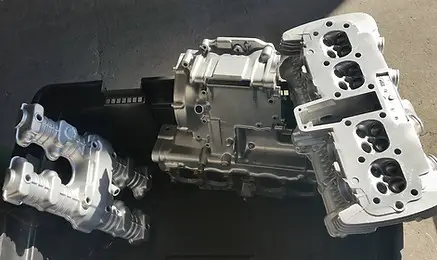

Correctly prepared metal – blasted to profile, inspected against the standard and coated without delay – produces a finish that holds. Powder coating applied to properly prepared steel regularly gives a decade or more of service without breakdown. The variable between those two outcomes is not the quality of the powder. It is what happened to the surface before the powder was applied.
Four technicians with 25–30 years of experience each know, in practice, what a surface needs to look like before a coat touches it. That knowledge does not live on a checklist. It is the product of doing this work, on these materials, for this long.
Abrasive Blasting in Melbourne’s North — Heidelberg West Workshop
Blast Off Surface Cleaning & Protective Coatings operates from a fixed workshop at 39 Crissane Rd, Heidelberg West VIC 3081.
A permanent, enclosed workshop lets us handle what mobile blasting cannot: full car bodies, complete chassis, heavy fabrications and large volumes of parts processed in a controlled environment. Drop‑off and collection from a fixed address means your job is run under the same conditions from start to finish – not on a suburban driveway with a compressor in a trailer.
Serving Heidelberg, Preston, Bundoora, Thomastown, Campbellfield and greater Melbourne, the workshop sits in the centre of the northern industrial corridor for a reason. This is where fabricators, fleet operators and restorers who need this kind of work have been based for decades.
Blast Off has been part of that corridor for 30 years, now under new ownership with the same senior team on the floor. One customer, Mick Spence, has been bringing his work to Heidelberg West for 17 of those years. A quality‑conscious car restorer does not return to the same workshop for 17 years because the price was acceptable. He returns because the work was right, every time.
Gallery


Frequently Asked Questions
What does sandblasting do?
Abrasive blasting drives media at high pressure across metal to strip rust, old paint, coatings and mill scale back to bare metal. At the same time, it creates a surface profile – microscopic roughness that gives the next coating its mechanical anchor. Without that profile, even a high‑quality powder coat cannot bond correctly to the metal beneath it.
Why is sandblasting required before painting or powder coating?
Industry data attributes up to 80% of coating failures to inadequate surface preparation. Paint or powder applied over contamination, mill scale or a surface without enough profile will blister, peel or delaminate long before its time. Abrasive blasting to AS 1627.4 is the method that reliably delivers the cleanliness and profile a lasting finish requires.
How much does it cost to sandblast wheels?
Pricing depends on wheel size, material, current condition and whether powder coating follows. Corrosion level and any existing coating that needs to be stripped also affect cost. Contact Blast Off at the Heidelberg West workshop for a specific quote. The price you are quoted is the price you pay at pickup – no extras added at collection.
How long does sandblasting take?
Turnaround depends on job size, condition and current workshop load. Blast Off confirms a realistic timeframe at quote stage so there are no surprises mid‑job and no chasing required. Smaller batches are often turned around within a few days; larger or heavily corroded jobs take longer, and you will know that up front.
What is the difference between sandblasting and softer abrasive media — and which one suits my job?
Harder media like garnet produces the aggressive surface profile that steel and heavily corroded substrates need. Softer media such as glass beads are used for aluminium alloys, heritage ironwork and any part where surface finish and dimensional tolerance matter. Blast Off selects the correct media and pressure at quote stage, based on your substrate and intended finish – before the job enters the cabinet, not after.
Need Abrasive Blasting in Melbourne?
Call (03) 9455 1366, email info@blastoffaustralia.com, or visit our Heidelberg West facility for expert abrasive blasting and protective coatings.