

Powder Coating in MELBOURNE
Cars & Industrial Parts
If your powder coat is peeling, bubbling or rusting at the edges, the powder itself is usually not the problem. Industry data says roughly 75–80% of coating failures come back to one thing: poor surface preparation before the coating ever went on.
At Blastoff Surface Cleaning & Protective Coatings, abrasive blasting is not a bolt‑on service to sell more coating. It is the core of what we do. We blast first, to spec, then coat on top of a surface we trust. That is why our finishes last.
- 30+ years preparing and coating metal for Melbourne restorers and industry
- In‑house abrasive blasting: sand, bead and garnet matched to your parts
- Primer included on every job as standard, not a paid extra
- Single‑source blast‑and‑coat: one quote, one workshop, one turnaround
- Fast, predictable lead times with no hidden costs or surprise extras
ENQUIRE NOW
EXCELLENT Based on 22 reviews
 Posted on Google
 Arthur ZavrasI had some bespoke grip strength and strongman gym equipment made from mild steel. I asked for a rough texture and was very happy with the result. It exceeded my expectations. Quick turnaround, easy communication and reasonable price. Great team, I highly recommend them if you are considering the service.Posted on Google
 John CraddockVery helpful staffPosted on Google
 El VisVery happy with the quality of work and The professional advice givenPosted on Google
 Rajeev sehgalThe Best in the Business 👌Posted on Google
 Chris SproulBlast off are simply the best. Great price, great quality and fast turn around. A+++Posted on Google
 S G UnitPeter is super helpfull quick turnaround and fairpricedPosted on Google
 Mick SpenceI first had my E.H holden fully sandblasted by Peter and his dad around 17 years ago when they were a new business. Since then, I've had them do a fair amount of stripping to confidently say they are always honest , upfront and cheap. They are good family and is no wonder why they are respected in the panel and paint game.Posted on Google
 xPRIESTxPete’s the man, great work thanks heaps mate very very happy 😊Posted on Google
 SkarajewPete and the team are specialists in looking after car restoration projects. Wouldn't go anywhere else.
Why Powder Coating Fails – It’s Not Just the Powder
What Actually Happens Under a Failed Coat
Most people see a peeling powder coat and blame cheap powder or a bad cure. It almost never starts there. The failure usually begins before the gun comes out, in the preparation – or the lack of it.
Oil residue, mill scale, existing paint and moisture contamination all stop the electrostatically charged powder from bonding directly to bare metal. The coating looks fine on day one. Weeks or months later, it starts lifting, not by gradually wearing away, but by delaminating at the interface between the film and the substrate.
One commenter described it precisely in an industry discussion:
“Once the coating cracks and starts to peel, it makes for a perfect rust and corrosion environment. The coating will lift slightly allowing moisture (water) to creep under it.”
Rust then forms in a sealed, oxygen‑poor cavity beneath the lifted coat, invisible until the film separates completely and the extent of the damage announces itself. By that point, you are not looking at a cosmetic problem. You are looking at metal that has been corroding in the dark for months and now needs to be stripped back to bare and done properly.
Why Spot Repairs Are Not an Option
Paint can be touched up. Powder coating cannot. That difference matters far more than most people realise until they are staring at a failed job.
The same chemistry that makes powder coating so durable is what makes partial repair impossible. The fused, continuous film formed in the curing oven cannot accept a new patch of powder bonded into an existing finish. If it fails, the whole part has to come off, go back to bare metal and start again.
One owner documented this after a failed coat on a set of roof rails:
“there is no quick/easy/inexpensive way to fix it…the rail will have to be removed, sand-blasted, cleaned, and then the whole thing powder coated again, at a cost of several hundred dollars”
A failed powder coat does not just cost you a recoat. It costs you the original job, plus the strip, plus the blast, plus the recoat, plus the weeks in between. That is the real price of a cheap quote that skipped proper preparation.
The Blastoff process starts where every failed coat should have started: with correct blasting and cleaning before any powder is ever loaded into the gun.
The Blast Off Process – Surface Preparation Before the Gun Comes Out
Abrasive Blasting to Bare Metal
Blast Off was built on blasting. For over 30 years, the core business has been abrasive blasting – sand, bead and garnet – which means surface preparation is not an add‑on to a coating operation. It is the operation. Every part that comes through the workshop at 39 Crissane Rd is blasted back to bare metal before any powder is loaded into the gun.
Every existing coating, every trace of rust, every layer of mill scale and surface contamination is physically removed. The substrate that arrives at the coating step is clean, profiled and ready to bond – not just “assumed” clean because it looked acceptable on delivery. Shops that live mainly on the coating side of the equation either outsource this step, abbreviate it or skip it. Blast Off does it in‑house, on every job, as the foundation of everything that follows.
Phosphating for Adhesion
Bare metal is not the finish line. After blasting, every part goes through Blast Off’s priming process, a paint pre‑treatment that deposits a conversion (phosphate) layer directly onto the substrate. This layer significantly improves powder adhesion and provides a first line of corrosion resistance before the powder‑coat primer and then top‑coat colour are applied.
Without etch priming, the powder bonds mechanically, gripping the surface profile created during blasting. With etch priming, the bond is both mechanical and chemical – and the difference in long‑term performance is not marginal. Komaspec, in their published coating research, puts it plainly:
“A poorly treated surface will never result in a good powder coating finish. With a well-prepared surface, great finishes can be achieved.”
Etch priming is standard practice at Blast Off. You will not be asked to pay extra for it.
Powder Application and Oven Cure
With the substrate profiled and pre‑treated, the powder is applied electrostatically. Charged dry powder is sprayed onto the grounded part, adheres uniformly across the surface, and the part moves into the curing oven. Heat brings the powder to the manufacturer’s specified temperature, the film melts and flows, and the chemical reaction locks in a continuous fused surface that no brush or spray‑paint process can replicate.
The standard that governs what the substrate must look like before any of that happens is ISO 8501‑1, the internationally recognised benchmark that specifies how clean a steel surface must be and how much surface profile it must carry before a protective coating is applied. It removes guesswork from the prep stage and replaces it with a defined, verifiable standard.
At Blast Off, that assessment is carried out by four technicians, each with 25 to 30 years of hands-on industry experience. Reading a surface is a skill developed across thousands of jobs, not a box you tick on a checklist.
How Long Does Powder Coating Last – The Honest Answer
A correctly prepped and applied powder coat typically delivers 15–20 years of service life in normal conditions. Conventional paint on the same parts and in the same environment usually lasts 3–5 years. These are not Blast Off warranties – they are consistent figures across multiple independent sources and reflect what the process can deliver when the preparation behind it is done properly.
The variable that puts your job at the top or bottom of that range is not the powder brand. Two identical powders, applied by the same operator on the same day, will perform very differently if one is sprayed over a correctly blasted and phosphated substrate and the other is not. The powder is the finish. The prep is what the finish is built on. Get that wrong and no powder product will save it.
Steel vs Aluminium – Why Substrate Matters
Steel bonds reliably to powder coating when it has been correctly blasted. Abrasive blasting creates a mechanical surface profile – a fine texture the coating can physically grip. Add etch priming on top of that and the bond becomes chemical as well as mechanical. Skip either step and service life shortens dramatically, no matter where the finished part is used.
Aluminium behaves differently. The surface is softer and does not hold a blasted profile the same way steel does. On its own, it is less receptive to purely mechanical adhesion. Without correct pre‑treatment, aluminium is one of the most failure‑prone powder‑coating substrates there is. Blast Off’s etch‑priming process creates the chemical conversion layer that aluminium needs before any powder adhesion can be considered reliable.
Three conditions consistently shorten coating life on any substrate – and they show up in almost every failed job we see:
- Applying powder over existing paint instead of stripping to bare metal first
- Omitting the etch‑priming step between blasting and coating
- Surface contamination (oil, salt residue or moisture) present at the time of application
Each of those conditions is eliminated by the Blast Off process before the part ever reaches the coating stage.
What We Powder Coat in Melbourne – And Why Prep Is Non‑Negotiable Here

Automotive and Restoration
Blast Off has been a go‑to workshop for classic car restoration in Melbourne’s north for more than 30 years. One customer, Mick Spence, has been bringing work through the door for 17 of those years. His first job was a full blast of his EH Holden; he has been returning ever since. Relationships like that are not built on being the cheapest quote in the corridor. They are built in a shop that knows exactly what a restoration‑grade surface must look like before a single coat goes on, and delivers that standard every time.
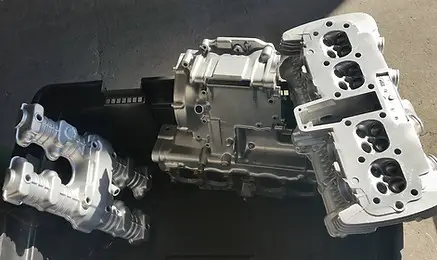
Automotive work at Blast Off covers alloy wheels, chassis, suspension arms, roll cages, motorcycle frames and classic car body components in both steel and aluminium. For wheel‑specific restoration work, including condition assessment and refinishing options, see the Wheel Restoration page.
Industrial and Commercial
Fabricators, workshop operators and fleet managers in Melbourne’s northern industrial corridor – Thomastown, Campbellfield, Heidelberg West, Dandenong – use Blast Off as a single‑source provider for surface preparation and powder coating combined.
Splitting blasting and coating between two different shops is not just inconvenient. It creates real risk: contamination between steps, inconsistent surface profiles and an accountability gap when a finish fails and both parties point at each other. Blast Off handles abrasive blasting, phosphating and powder coating under one roof. The part arrives dirty. It leaves coated. One quote, one turnaround, one person to call.
Work in this category includes machinery guards, fabricated steel components, equipment frames, racking, balustrades and gates. Nothing on that list needs to be split across multiple providers.

Melbourne’s Environment – Why This Matters Here
Corrosion costs the Australian economy an estimated $32 billion per year, according to Curtin University research. That is a national figure, but the conditions driving it are local – and Melbourne concentrates several of them.
Bayside and Port Phillip suburbs carry salt‑laden air that settles on metal surfaces and pushes corrosion from the outside in. Summer UV across Melbourne slowly degrades coating adhesion. Inland suburbs cycle through cold, damp winters that pull moisture into every surface flaw a coating did not seal. Powder Coating Industries, an Australian industry source, notes that even painted metal can fail within 12–36 months in coastal conditions if the coating is thin, chipped or poorly prepared.
In Melbourne’s environment, preparation quality is not a luxury extra. It is what separates a coating that merely survives its first few years from one that earns its keep for a decade or two.
Powder Coating Cost – Why the Cheapest Quote Often Costs the Most
Powder coating services in Melbourne vary in cost because each job is different. Final price depends on substrate size, material type, whether an existing coating must be stripped before blasting can begin, and how many coats the spec calls for. Blast Off quotes are given on enquiry, not from a generic price list, because a set of alloy wheels and a pallet of fabricated steel brackets are not the same job and should not be priced as if they are.
What the quote includes matters as much as the number on it. Every Blast Off quote covers abrasive blasting, phosphating and powder application as one complete process, because splitting those steps is exactly where coating failures begin. Preparation is not an optional extra line you can cross out. It is what the price is for.
Defusco Industrial Supply notes that cutting corners on surface preparation can make failure three to five times more expensive to fix than doing the job correctly the first time. A full recoat carries the same price as the first coat, plus the cost of stripping the failed finish and blasting back to bare metal before anything new can go on. One owner summed it up after a set of roof rails failed:
“there is no quick/easy/inexpensive way to fix it…the rail will have to be removed, sand-blasted, cleaned, and then the whole thing powder coated again, at a cost of several hundred dollars”
The best powder coating price is the one you only pay once.
Gallery


Frequently Asked Questions
How much does powder coating cost?
Pricing depends on four main factors: part size, material type, pre‑treatment required and the finish specified. Steel and aluminium need different preparation, and that changes the scope and cost. Surface preparation is the variable most people underestimate, and it is the variable that decides whether a finish lasts two years or twenty. Contact Blast Off for a no‑obligation, itemised quote.
How much is powder coating for wheels?
Wheel pricing depends on diameter, material and current condition. If an existing coating needs to be removed before blasting can begin, that changes the job size. Blast Off uses either the burn‑off oven or abrasive blasting to strip wheels, depending on what the coating and the wheel require. Inspection determines the prep process, and the prep process determines the quote. For full detail, see the Wheel Restoration page.
How is powder coating done?
At Blast Off, the process runs in four steps: abrasive blasting to bare metal, etch‑priming pre‑treatment for adhesion, electrostatic powder application and oven cure. Steps one and two are where most powder‑coating failures originate – and where Blast Off’s core 30‑year capability sits. Full detail on the blasting stage is on the Abrasive Blasting service page.
How long does powder coating last?
As an industry benchmark, a correctly prepped and applied powder coat typically lasts 15–20 years – four to five times the service life of conventional paint in similar conditions. Surface‑preparation quality is the primary determinant of lifespan. Not the powder brand, not the colour, not the oven temperature. See Abrasive Blasting for what correct preparation actually involves.
Can you powder coat on site?
No. Powder coating requires electrostatic application equipment, a controlled environment and a curing oven – none of which can be brought to site. All work is done at Blast Off, 39 Crissane Rd, Heidelberg West. Fast, predictable turnaround with no hidden costs. Get in touch to arrange a drop‑off or discuss what your job needs.
Need Abrasive Blasting in Melbourne?
Call (03) 9455 1366, email info@blastoffaustralia.com, or visit our Heidelberg West facility for expert abrasive blasting and protective coatings.