

Rust eats steel. Paint peels. Contamination spreads. Industrial sandblasting reverses decades of damage in hours, not days. At our Melbourne facility we handle everything from a single bracket or wheel set to 50‑tonne press components and full plant shutdowns. You drop it once, we blast it clean and return it ready for your painter, coater or maintenance team.
Thirty years of stripping heavy machinery and intricate food‑grade equipment teaches you precision and discipline. Manufacturers, fabricators and processors use us because missed deadlines and rework cost more than doing surface prep properly the first time. Our job is simple: hit the spec, hit the profile, hit the deadline, every time.
Blowing grit at steel is the easy part. Choosing the right media, pressure and nozzle is what protects your asset. Containment and dust control keep your site and operators safe. Correct surface profiling gives your primers and protective coatings something to bite into, reducing corrosion, flaking and unplanned shutdowns years down the track.
Industrial sandblasting, or industrial abrasive blasting, uses media like garnet, aluminium oxide or steel grit fired at high speed to clean and profile metal surfaces. The old silica sand is effectively banned in Australia because silicosis kills. Modern blasting media cuts faster, is safer to handle and leaves a more consistent surface for coatings.
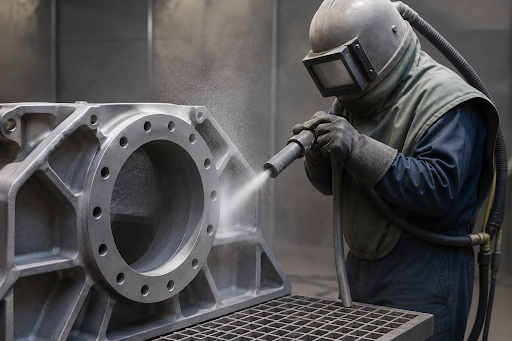
You need industrial sandblasting when wire brushing, grinding and hand prep will not touch it: heavy rust, thick multi‑layer paint systems, oil and contamination, or when a specification calls for a defined blast standard before coating, inspection or putting equipment back into service.
Prepared to AS 1627.4 (ISO 8501-1) visual cleanliness standards, which range from Sa 1 to Sa 3. For most protective coating systems, Sa2.5 is the gold standard. Achieving it consistently means controlled pressure, correct media and an even blast pattern that basic workshop cabinets and hobby gear simply cannot deliver across an entire structure.
Some environments demand even higher prep. Food-processing equipment requires specialized non-ferrous media blasting (like glass bead) to achieve exact Ra (Roughness Average) parameters for strict hygiene compliance, rather than heavy carbon-steel structural standards. These standards exist because shortcuts fail early, and failures in these environments are expensive.
Complex shapes, internal surfaces and blind holes need specialised nozzles and techniques to reach every face. Components over 2 tonnes need overhead handling and purpose‑built blast rooms. At that point, a professional industrial blasting shop is cheaper than rework, scrap or downtime.
Facilities handling pressure vessels, food‑contact surfaces or precision machinery use professional blasting because the cost of failure dwarfs the cost of correct surface preparation. Your required surface preparation standard should dictate whether in‑house work is enough or a specialist is the most cost‑effective approach.
Bringing your work to a dedicated blasting facility removes guesswork and workshop disruption. Heavy-duty compressors, blast pots, media handling and extraction systems are permanently installed and maintained, so you get consistent results without tying up your own space or staff.
Every job starts with an assessment. We identify material type, thickness, previous coatings and any sensitive areas that need masking or protection. Handling requirements, lifting points and storage are confirmed so your components move safely through the process from drop‑off to collection.
Once specs are agreed, we choose the right media, nozzle and pressure for the job, then blast to the required standard in our purpose‑built rooms. Dust and spent media are extracted and contained. Parts are then blown down, inspected and staged for pickup, ready for your painter, coater or maintenance team.
Every job starts with an assessment at our facility. Detailed walkthroughs identify lifting points, overhead obstacles, confined areas and proximity to sensitive electronics or food‑processing components. Some items need crane assistance and spreader bars, others must fit through standard doorways and navigate tight turns on forklifts or trolleys.
We decide which blast room, media and nozzles to use based on material, size and required standard. Equipment positioning inside the booth considers extraction flow, visibility, drainage and how parts will be rotated to reach internal faces and complex geometries. Permanent 3‑phase power, high‑capacity compressors and dust extraction are already in place, so setup focuses on safe handling and correct staging, not building a temporary site.
Workspace preparation includes masking sensitive areas, hanging protective sheeting where required, placing media recovery equipment and setting clear communication points with your supervisors for drop‑off and collection. Setup typically takes 2–3 hours for large or complex jobs, less for standard batches once we know your components.
During active blasting, surface condition guides ongoing media and pressure adjustments. Technicians monitor blast patterns using 10x magnification and surface profile gauges to maintain the specified standard, typically Sa2.5, across complex shapes and varying thicknesses.
Quality checkpoints run roughly every 30 minutes during longer blasts. Immediate surface profile verification using replica tape prevents over‑blasting expensive components and ensures we are not under‑prepping critical areas. Digital photography documents progress and final condition for your quality assurance records.
Radio and face‑to‑face communication keep our blasting team aligned with your maintenance or production supervisors on timing and priorities. Completion times adjust for the actual surface conditions we uncover once blasting starts. Post‑completion inspection includes full surface profile verification, contamination checks where required, and a photographic record before components move on to coating, reassembly or return to service.
Dust, noise and rebound media demand strict safety controls in a dedicated blasting facility. Our blast rooms, extraction systems, personal protective equipment and emergency procedures are designed to meet Australian respiratory protection requirements, including AS/NZS 1716 for approved breathing apparatus.
Before work starts, safety briefings cover blast room entry rules, emergency shutdown procedures, hand signals and radio protocols. Blast zones are clearly marked, interlocked and restricted to trained personnel only. Warning lights, signage and barriers prevent accidental entry while blasting is in progress.
Blasting technicians use supplied‑air respirators with breathing air purified and monitored to meet strict AS/NZS 1715 compliance standards to remove exposure to airborne dust and coating residues. Air supply and filtration are monitored continuously so contaminants stay below occupational exposure limits.
High‑capacity dust extraction and negative‑pressure control pull particles away from the operator and out of the blast room, through collectors rated for fine particulate capture. Systems are sized to process thousands of cubic metres of air per hour while still maintaining visibility for accurate work on detailed components.
Emergency breathing air reserves provide escape capability in the event of equipment failure. Confined blasting setups and any work involving lead‑based or hazardous coatings are supported by atmospheric testing for oxygen levels and toxic vapours before and during operation.
Within the facility, heavy‑duty sheeting and temporary barriers protect nearby equipment, electrical panels and production machinery awaiting processing. Precision surfaces are masked with specialised tapes and coverings rated to withstand blast pressures without leaving adhesive residue.
Blast rooms and prep areas use controlled entry systems to prevent dust migration into clean zones. Floor protection and drainage design manage spent media and washdown water so they can be collected and disposed of correctly.
Recovery systems capture spent media and debris using mechanical reclaim and industrial vacuums. Final cleanup includes compressed‑air blow‑down, removal of temporary protection and verification that adjacent equipment and walkways are free of contamination before the area is returned to normal use.
Sandblasting and shot blasting both use abrasive media, but in different ways. Sandblasting propels expendable media (like garnet or aluminium oxide) in single‑pass systems, ideal for jobbing work and mixed component sizes. Shot blasting uses recyclable steel media in enclosed machines that capture and reuse the shot hundreds of times, suited to high‑volume, consistent parts.
Shot blasting delivers more aggressive cutting action and deeper anchor patterns on heavy structural steel, especially where Sa3 standards and thick build coatings are specified. Sandblasting with garnet or aluminium oxide excels at removing paint and light to moderate corrosion while preserving base metal thickness, which is critical for precision components and thinner sections where dimensional tolerance matters.
The required surface profile is usually the deciding factor. Automotive components typically need a 25–50 micron profile, achievable with aluminium oxide sandblasting that cleans well without chewing up detail. Industrial machinery and structural steel needing heavy‑duty epoxy or polyurea systems often require 100+ micron profiles that steel shot or steel grit deliver more efficiently.
Food‑processing equipment benefits from stainless steel shot blasting where available, because it avoids ferrous contamination while achieving deep cleaning for hygiene compliance. On large‑scale projects, recyclable media systems can also reduce waste disposal volumes and costs when the work suits that method.
Equipment limits and part geometry also drive the choice. Shot blasting machines require significant floor space and structural support. Many cabinet systems only handle components up to around 2.5 metres and are optimised for simple shapes and repeatable batches. Larger fabrications, awkward geometries or fixed installations are better suited to sandblasting in purpose‑built rooms.
Complex internal surfaces, threaded connections and blind holes usually respond better to sandblasting, where the operator can direct media flow into tight areas. Shot blasting excels on plates, beams and external profiles where maximum throughput matters more than intricate detail. In practice, your coating spec, part size and required profile determine whether sandblasting or shot blasting is the most effective approach.
Industrial sandblasting facilities operate as fully self‑contained units. High‑capacity rotary screw compressors, multi‑port 6 cubic foot blast pots, and integrated dust collection systems are installed for continuous industrial operation. Systems typically run at 125 PSI working pressure with automatic moisture separation to protect media performance and surface finish.
Power comes from dedicated 415V three‑phase supply sized for blasting and extraction together, often drawing 75 kW or more during active blasting. A fixed plant gives you consistent pressure, airflow and visibility that portable setups struggle to match, especially on long shifts and heavy sections.
Redundancy is built into the plant. Backup compressors and secondary blast pots are available so work can continue during servicing or if a component fails. Technicians keep critical spare parts on hand, including blast nozzles, deadman switches, hoses and pressure relief valves, to minimise downtime.
Preventive maintenance includes daily compressor and dryer checks, regular blast pot and valve inspections, and scheduled hose integrity testing under pressure. This approach keeps uptime high across multiple blast rooms and long‑run industrial projects, so your schedule is not hostage to equipment failure.
Bulk abrasive is stored in silos or hoppers and fed to the blast system through mechanical or pneumatic delivery. Underfloor reclaim, screw conveyors and elevator systems return spent media to separators that remove dust, fines and contaminants. Magnetic extraction pulls out ferrous fragments, reducing media consumption and improving surface consistency.
High‑efficiency dust collectors and, where required, misting or suppression systems manage airborne particles inside and around the blast rooms. Effective media recovery and air handling cut waste disposal volumes, lower abrasive costs and keep the facility clean and safe for ongoing work.
Surface area, contamination levels, access requirements and finish standards determine project cost. Industrial components requiring Sa 2.5 preparation typically range from $45–$85 per square metre, while delicate automotive panel stripping is quoted on a specialized, low-pressure project basis to prevent sheet metal warping. Complex machinery with multiple coating layers, heavy rust or intricate masking can reach $120–180 per square metre due to extended processing time and specialised media.
Free initial consultations provide detailed written quotes within 48 hours. We measure actual surface areas, assess coating and contamination types, and identify handling or access challenges that affect equipment setup time and overall pricing.
Standard pricing covers surface preparation to the agreed standard, standard abrasive media, masking of basic non‑blast areas, in‑facility containment and post‑blast cleanup. Additional charges apply where cranes, specialised lifting gear or non‑standard packaging are required for large or delicate components. Extended projects that require dedicated storage areas, after‑hours supervision or weekend operation are quoted with clear supervision and facility access fees.
Premium media such as aluminium oxide or specialised stainless steel abrasives attract supplementary charges based on actual consumption. Components with complex geometries that demand extended hand‑held detail work, internal surfaces or thread protection are quoted separately at $195 per hour.
Projects under $5,000 require a 50% deposit at booking, with the balance due on completion and acceptance. Larger industrial contracts can be structured with milestone billing aligned to maintenance windows, shutdown schedules and internal budget cycles.
Professional abrasive blasting typically delivers 60–80% time savings compared to chemical stripping or manual preparation. When you factor in reduced production downtime, lower rework rates and longer coating life, higher upfront blasting costs usually become the most economical option over the full life of the asset.
Melbourne’s industrial sector needs blasting specialists who actually understand local plants, shutdown windows and compliance standards. For over thirty years we have supported automotive manufacturers around Clayton, food processors across the western suburbs and marine fabricators around Port Phillip Bay.
Our facility in Heidelberg West services sites from Geelong’s industrial precincts through to the Latrobe Valley. Established logistics and handling mean large and small components move in and out quickly, so your maintenance windows stay tight and predictable.
Client retention sits above 85% because facility managers know exactly what they get from us: consistent prep to spec, on time. Manufacturing supervisors in Dandenong South have used our blasting services for seven straight years, achieving coating adhesion results that extend maintenance cycles by 40–60%.
Complex projects highlight our technical capability: pharmaceutical mixing equipment needing inspection‑ready, regulated surface standards; heritage bridge components where we had to respect heritage overlays; precision tooling where dimensional tolerances measured in hundredths of a millimetre could not move.
Every completed surface goes through inspection and documentation before handover. Digital microscopy and photographic records verify cleanliness and coverage. Surface profile measurements using calibrated replica tape provide hard evidence that the specified preparation standard has been met.
This systematic quality control is what prevents costly callbacks, premature coating failures and unplanned shutdowns that often follow work done by less experienced contractors.
Manufacturing facilities throughout Melbourne’s industrial corridors rely on our surface preparation expertise. We handle everything from 15‑tonne injection‑moulding machines at Dandenong fabricators to intricate food‑processing equipment that needs aggressive cleaning without damaging critical surfaces.
Automotive workshops across the northern suburbs depend on our chassis cleaning and component stripping services, particularly for classic car restorations that need bare‑metal preparation without warping thin panels. We blast wheels, suspension components, brackets and frames so they are clean, profiled and ready for primer or coating.
Automotive applications prioritise dimensional accuracy and panel integrity over extremely rough profiles. Media and pressure are chosen to remove paint, rust and contamination while preserving base metal and detail.
Bridge maintenance and construction contractors send structural steel, handrails, beams and connection hardware to our facility when controlled workshop blasting delivers better results than on‑site methods. Builders throughout the south‑eastern suburbs use our services for architectural metalwork, balustrade systems and façade components that must arrive on site clean, profiled and ready for coating or installation.
Food‑processing facilities in Tullamarine and across Melbourne’s west demand high‑standard surface preparation on frames, guards and equipment for hygiene and inspection compliance. Asset owners and facility managers use our documented blasting process on critical infrastructure items so they can show surfaces were prepared to the specified standard before coating and return to service.
Industrial sandblasting typically demands 375–400 CFM of air at a sustained 125 PSI working pressure. Our facility uses high‑capacity rotary screw compressors with dryers and automatic moisture separation to maintain consistent pressure and clean, dry air. Standard factory air supplies rarely meet these requirements continuously, which is why serious blasting is done on dedicated equipment rather than relying on plant air lines.
Surface preparation starts with degreasing using industrial solvents to remove oils and contaminants. We then mask precision surfaces, electrical components and any non‑blast areas with appropriate tapes and covers. In shared prep areas, heavy‑duty plastic sheeting and barriers are used to create defined blast zones with controlled entry points. Sensitive equipment such as computerised controls or food‑contact surfaces receive additional shielding and separation so blasting dust and media stay where they are supposed to be.
Technicians wear supplied‑air breathing apparatus with AS/NZS 1715 compliance standards breathing air quality and operate under continuous atmospheric monitoring where required. Emergency procedures include 15‑minute escape air reserves and clear immediate shutdown protocols for any loss of air, visibility or control. All personnel within the designated blast zone and surrounding areas must use hearing protection, as noise levels during active blasting can exceed 95 decibels.
Sandblasting removes contamination and creates an anchor pattern in a single process. Chemical stripping only removes coatings and does not provide surface texture for coating adhesion. Manual grinding is 8–10 times slower on large areas and cannot produce a consistent profile on complex geometries. Power‑tool cleaning can reach a maximum of St2 standards, whereas correctly performed sandblasting achieves St2.5 to St3 grades required for long‑term coating performance.
Project duration depends on surface area, coating thickness and contamination levels. A standard 20‑square‑metre component usually requires 4–6 hours including setup and cleanup. Once active blasting begins on larger assemblies, we typically process 5–8 square metres per hour, with exact timings confirmed during quoting.
For professional industrial sandblasting services across Melbourne. With over thirty years of experience, we deliver surface preparation standards that protect your coating investment and reduce long‑term maintenance costs.