

Most coating failures start before a drop of paint is applied; choose a Melbourne industrial sandblasting contractor who controls every step in-house.
A general painter starts at the tin. An industrial contractor starts at the substrate: metal type, existing corrosion, required surface profile, environmental exposure. Get these wrong, and the coating fails, regardless of what goes on top. These aren’t cosmetic decisions. They’re engineering ones.
Send parts to a third party for industrial sandblasting in Melbourne, and you lose control of three critical variables: the anchor profile, the timing between blast and coat, and the moisture exposure window. Any one of those breaks adhesion. All three and you’re stripping and recoating inside 18 months.
Keeping blasting in-house means the surface moves from blast cabinet to coating without sitting in a van overnight or waiting on a subcontractor’s schedule.
Phosphating is a chemical conversion process applied to ferrous metals before topcoating. It creates molecular-level bonding between metal and coating, not just mechanical keying from the blast profile. Most general painters don’t offer it because running the process requires infrastructure they’ve never invested in.
Skip phosphating on a ferrous substrate, and you’re relying entirely on mechanical adhesion. Shorter service life, full stop.
Every job starts with a substrate assessment: metal type, existing corrosion, surface condition, and what the finished coating needs to withstand. That determines everything downstream.
Media selection comes next. Sand cuts hard and fast on heavily corroded steel. Garnet gives a cleaner, more controlled anchor profile on structural components. Glass bead is used where a finer finish is required, such as alloy wheels, aluminium castings, and precision engine parts. For a full breakdown of how each blasting media is selected and applied, see our abrasive blasting services page.
All industrial sandblasting in Melbourne is handled entirely in-house. No subcontracting. No parts sitting in transit between blast and coat.
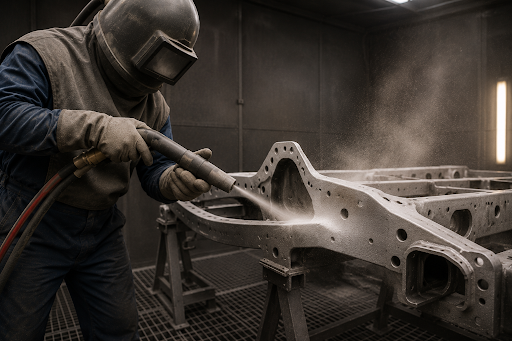
On ferrous metals, the clock starts the moment blasting stops. Atmospheric moisture begins oxidation on a freshly blasted surface within hours, faster in humid conditions. That window between preparation and coating is a quality control variable, not a scheduling convenience.
Keeping both processes under one roof eliminates it entirely.
Phosphating is applied before topcoat on ferrous substrates. Hydroblasting is used where scale, contamination, or surface chemistry requires a wet process rather than abrasive media alone. Every step, assessment, blast, conversion treatment, coating, is completed by the same team of four technicians, each with 25 to 30 years of hands-on experience. No handoffs. No guesswork.
Blast Off built its Melbourne reputation here. Chassis preparation, steel and alloy wheel restoration, engine components, intake manifolds, housings, castings. Work that demands precise media selection and a clean surface profile, not a rushed turnaround from a shop treating it as a sideline.
For wheel-specific work, see our wheel restoration services page.
Structural steel, plant equipment, machinery housings, frames. Substrates operating under load, heat, and continuous contact need a coating system matched to those conditions, not a generic topcoat applied over inadequate prep.
Coating selection differs materially across these sectors. A food processing environment demands chemical resistance and hygiene compliance with no relevance on a structural steel frame. Marine environments introduce salt exposure and immersion variables that change primer selection entirely.
Melbourne workshops and facilities managers across these sectors have been bringing work to Blast Off for decades. That range is real, built substrate by substrate, not claimed on a brochure.
For detail on how coating systems are selected across these applications, see our industrial painting services page.
Subcontracting the blast means someone else controls the anchor profile and the gap between prep and coating, two variables that directly determine adhesion quality.
“We use sand” is not an answer. Media selection should reference the material, the required surface profile, and what coating is going on top.
Phosphating creates molecular-level bonding on ferrous metals before topcoat is applied. A contractor who doesn’t know what it is has answered the question.
Not what brand, what system, and what about this substrate and its operating environment drives that specification.
Get the scope in writing. A quote that shifts at collection is a scope that was never properly defined.
Accurate matters more than fast. A contractor who communicates delays is easier to work with than one who doesn’t return calls.
Blast Off has been operating in Melbourne’s automotive and industrial markets since the early 1990s. The technical team hasn’t changed. Four technicians, each with 25 to 30 years of hands-on experience, still run the floor.
New ownership since May has strengthened the operation without disrupting the team, the processes, or the client relationships built over three decades.
What that continuity means practically: the technician assessing your substrate is the same person running the blast and specifying the coating. That single chain of judgement is what prevents the mismatches that surface six months after a job is signed off by someone who never touched the metal.
Four technicians. Thirty-plus years. In-house blasting. Every process completed on-site in Heidelberg West by the same experienced team that was doing this work before most general painters started quoting industrial jobs.
That gap between blast completion and coating application is where most industrial painting jobs are quietly compromised. The surface looks clean. The profile is there. But if moisture has begun forming a micro-layer of flash rust, the coating is bonding to oxidation, not to clean steel.
Flash rust, light surface oxidation forming on freshly blasted ferrous metal before coating is applied, is invisible at a glance and damaging at a molecular level.
A contractor who sends parts to a separate blasting facility cannot control that window. The part gets blasted, loaded into a van, and waits on a delivery run or a scheduling gap. By the time it reaches the coating stage, the clock has already run down, often without anyone acknowledging it. This isn’t an edge case. It’s a structural problem with any workflow that separates blasting and coating across different sites or operators.
Blast Off handles blasting and coating under the same roof in Heidelberg West. The surface moves from blast cabinet to coating without leaving the facility, without waiting on a third party, and without the moisture exposure that accumulates in transit or overnight storage.
An industrial painting contractor manages the full preparation sequence, blasting, surface profiling, phosphating where required, and coating system selection matched to the operating environment. The distinction is in-house capability and process depth, not just the product applied.
Ask how they select blasting media and what coating system they’d specify for your substrate and environment. Genuine capability produces a specific answer. At Blast Off, substrate assessment happens before any quote is issued. If they can’t tell you why garnet over sand, they’re guessing.
Turnaround depends on substrate size, condition, coating system, and current job volume. No honest contractor quotes a fixed timeline without seeing the job. Contact Blast Off for a realistic estimate based on your specific scope.
The full checklist is higher on this page. Lead with two: is blasting done in-house or subcontracted, and is the quote fixed or variable at collection. Those two questions eliminate most contractors before you go further.
Industrial painting involves substrate-specific preparation, coating systems engineered for operating conditions, chemical exposure, temperature, immersion, and in-house blasting capability. Commercial painting is finish-focused, typically applied to new or pre-prepared surfaces. The difference matters most when an asset operates in conditions that destroy a surface-level coating within 12 to 24 months.
For a detailed sandblasting quote and see why Melbourne’s restoration community has trusted our team for more than 30 years.